Yeouth Retinol Serum for Face with Hyaluronic Acid & Vitamin E - Unisex Skin Serum, 1 oz
YEOUTH

How to Choose Your First Retinol
Retinol is one of the most talked-about skincare ingredients for fine lines, uneven texture, and dullness. It also has a reputation for causing redness, dryness, and flaking when people start too fast. If you are buying your first retinol serum, you want a formula that is easy on your skin, easy to fit into your routine, and clear about how to build up use.
This guide explains what to look for and compares five widely available options: YEOUTH, Kiehl's, PURITO, medicube, and Neutrogena.
For first-timers, the ingredients around the retinoid matter almost as much as the retinoid itself. Look for hydrating and barrier-supporting ingredients such as hyaluronic acid, ceramides, aloe, or vitamin E. These help offset the dryness that retinoids can cause.
A good beginner product tells you how to start. Most of the serums here recommend a few nights a week at first, then increasing as your skin adjusts. If a formula is meant for daily use from day one, the brand should say it was designed with tolerance in mind.
Fragrance is a common irritant. Skipping it is a simple way to lower the odds of a reaction while your skin gets used to a retinoid.
Most beginner products use retinol. Some also include retinal (retinaldehyde), another form of vitamin A. Products that combine forms or lean on retinal may feel more "active," so they are worth approaching slowly.
Serums can be watery, lightweight fluids, or oils. Think about how the product will layer with your moisturizer and whether you prefer to use it at night only or have the option of morning use.
Of the five, this is the one most explicitly designed for new users. Kiehl's describes it as a micro-dose formula meant for daily use from the start, with minimal visible redness, dryness, or peeling. It pairs pure retinol with ceramides to support the moisture barrier and a peptide for skin integrity. It is fragrance-free and labeled suitable for all skin types, including sensitive skin.
It is also flexible: the brand says it can be used morning or night, as long as you wear SPF during the day, and it can go on the neck, chest, and hands. You can apply it around the under-eye and crow's-feet area while avoiding the eyes, eyelids, and lips.
Best for: Shoppers who want a dedicated beginner formula and a simple daily routine.
YEOUTH pairs retinol with hyaluronic acid, vitamin E, and aloe vera, which gives it a hydrating, soothing lean. The brand positions it as gentle for sensitive skin and gives a clear schedule: start two to three times a week and work up to nightly. It suggests applying a small amount while your face is still damp, then following with moisturizer.
It is free of artificial fragrances, colors, parabens, and sulfates, and it is cruelty-free. The lightweight, non-greasy texture is described as pairing well with vitamin C, peptide, and hyaluronic acid serums.
Best for: Beginners with dry or easily irritated skin who want a slow, structured start.
PURITO is the only product here that lists its concentrations: 0.1% retinol and 0.1% retinal, plus NAD+. The percentages are modest, and the brand markets it for sensitive skin, but combining two retinoid forms is a step beyond a single-retinol formula. It is intended for nighttime use, starting two to three times a week.
One practical note: it is a two-phase formula with visible capsules that can separate, so you need to shake it well before every use. It comes with a dropper and has a lightweight, fluid feel.
Best for: Beginners who like knowing exact percentages and don't mind a slightly more involved product.
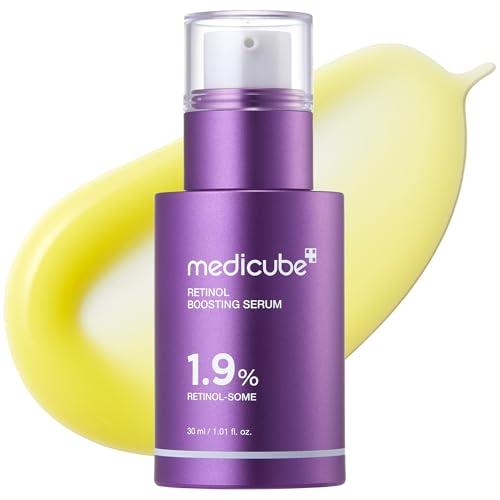
medicube uses a retinol-based complex (the product name also references retinal) along with peptides and vitamins, with an emphasis on firming and plumping. It is described as a low-irritation formula gentle enough for sensitive skin. Instructions call for evening use, beginning every other night and adjusting based on tolerance, with sunscreen during the day. The brand notes retinol is sensitive to light and heat, which is why nighttime is recommended.
Best for: Beginners whose main goal is firmer-looking skin and who are comfortable using it only at night.
Neutrogena's option is a face oil rather than a water-based serum, described as super concentrated and aimed at deep, stubborn wrinkles and dark spots. It uses pure retinol and is free of parabens, mineral oil, and dyes. The brand says it is dermatologist tested and suitable for daily use for all skin tones.
Because it is positioned as a concentrated treatment for deeper wrinkles and the facts don't include a gradual start schedule, cautious beginners may want to begin with fewer applications per week. The oil format may suit people with dry skin who like a nourishing feel.
Best for: People targeting more established wrinkles who prefer an oil texture.
Most beginner formulas recommend starting two to three nights a week and building up as your skin tolerates it. Kiehl's Micro-Dose is an exception, designed for daily use from the start.
Some formulas, like Kiehl's Micro-Dose, can be used morning or night if you wear SPF. Others, including medicube and PURITO, are intended for evening use. Always follow the product's directions and wear sunscreen during the day.
Both are forms of vitamin A used in skincare. Some serums, like PURITO's, combine the two. If you are new to retinoids, start slowly with any formula that includes more than one form.
Yes. Following with a moisturizer helps reduce dryness, and all of the serums in this guide either recommend it or are designed to layer under one.
It can be, if you pick a gentle, fragrance-free formula and ease in. YEOUTH, Kiehl's, PURITO, and medicube are all marketed as suitable for sensitive skin.
YEOUTH
Neutrogena
Kiehl's
medicube
PURITO